Faecal testing in horses often refers to redworms. But did you know that there are both small and large redworms? Both belong to the strongyles, but their life cycles differ considerably. And that difference is important when it comes to understanding faecal testing.
Small and large redworms: a different life cycle
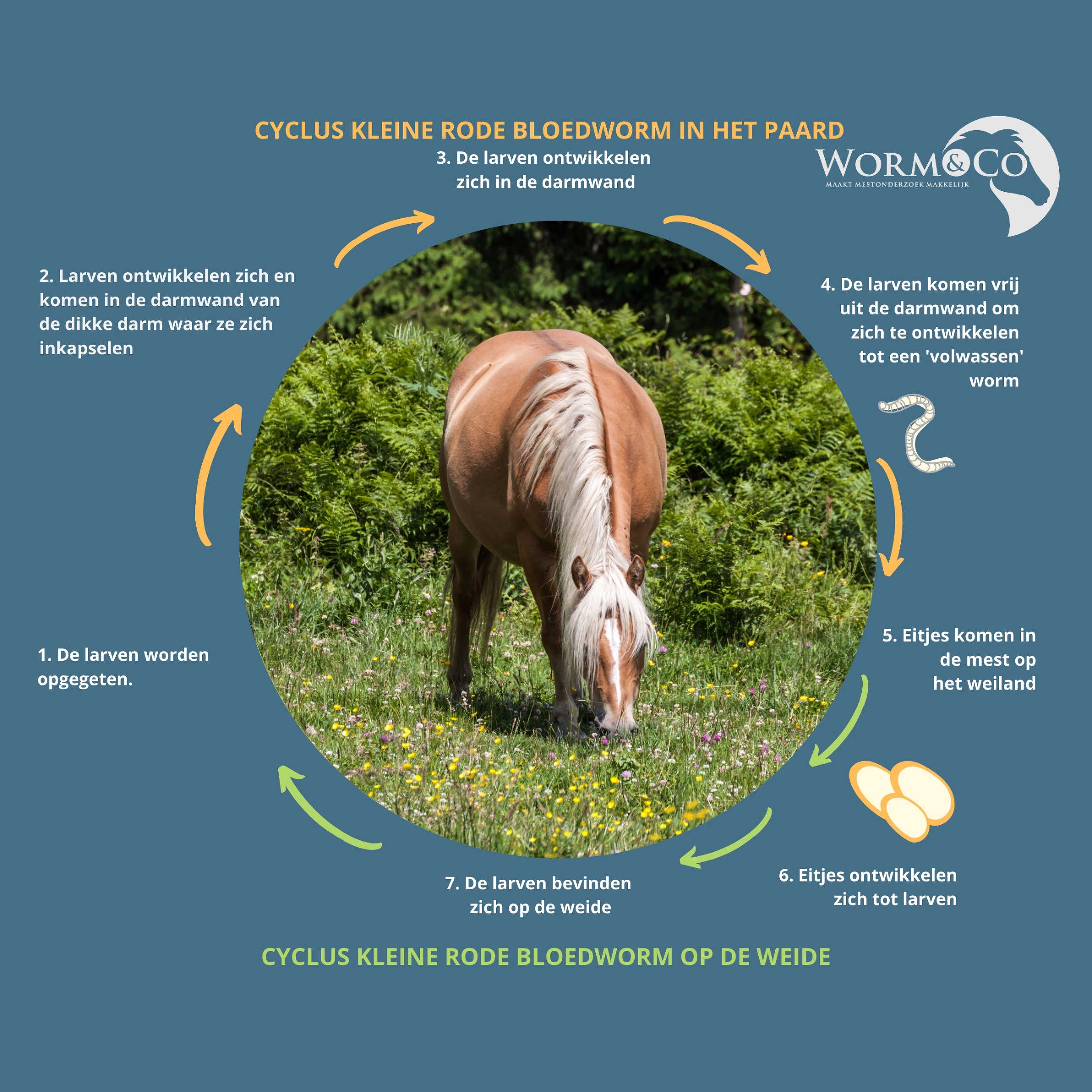
The life cycle starts in roughly the same way for both. Adult worms produce eggs that pass onto the pasture with the horse’s faeces. Larvae develop from these eggs and can be ingested by the horse while grazing.
This is where the difference begins.
Small redworms (cyathostomins) develop in the wall of the caecum and large intestine. The larvae can remain there in a dormant stage for an extended period. These are often referred to as encysted larvae. They can then resume their development, return to the intestinal lumen and eventually mature into adult worms.
Large redworms (Strongylus species) have a different life cycle. The larvae migrate from the intestine through other parts of the body. Strongylus vulgaris, in particular, is known for migrating through the blood vessels that supply the intestines. The larvae eventually return to the large intestine, where they mature into adult worms.
Why can't we tell the difference through faecal testing?
Under the microscope, we can identify the typical strongyle-type eggs. The difficulty is that the eggs of small and large redworms look so similar that they cannot be reliably distinguished from one another through routine faecal testing.
So, when strongyle-type eggs are found during a faecal examination, the egg itself does not tell us whether it came from a small or a large redworm.
Which redworm becomes encysted?These are the larvae of the small redworm (cyathostomins). These larvae can be present in the intestinal wall, where they temporarily suspend their development.
And this is an important limitation of faecal testing: encysted larvae cannot be detected through routine faecal testing.
Faecal testing detects eggs shed by adult worms. Encysted larvae are located in the intestinal wall and do not produce eggs yet. Therefore, a low or negative egg count does not automatically mean that a horse does not carry encysted larvae. Other immature or migrating worm stages may also remain undetected.
So, what does faecal testing tell us?
Faecal testing provides information about the shedding of worm eggs at the time of testing. This is valuable information for targeted worm management and helps determine when treatment is needed based on the detected egg count.
That is why it is important not to view faecal testing as an isolated moment, but as part of a broader worm management approach that also takes into account age, history, pasture management and previous test results.
Faecal testing therefore provides a lot of valuable information, as long as you also know what it cannot detect.

 NL
NL
 DE
DE
 FR
FR