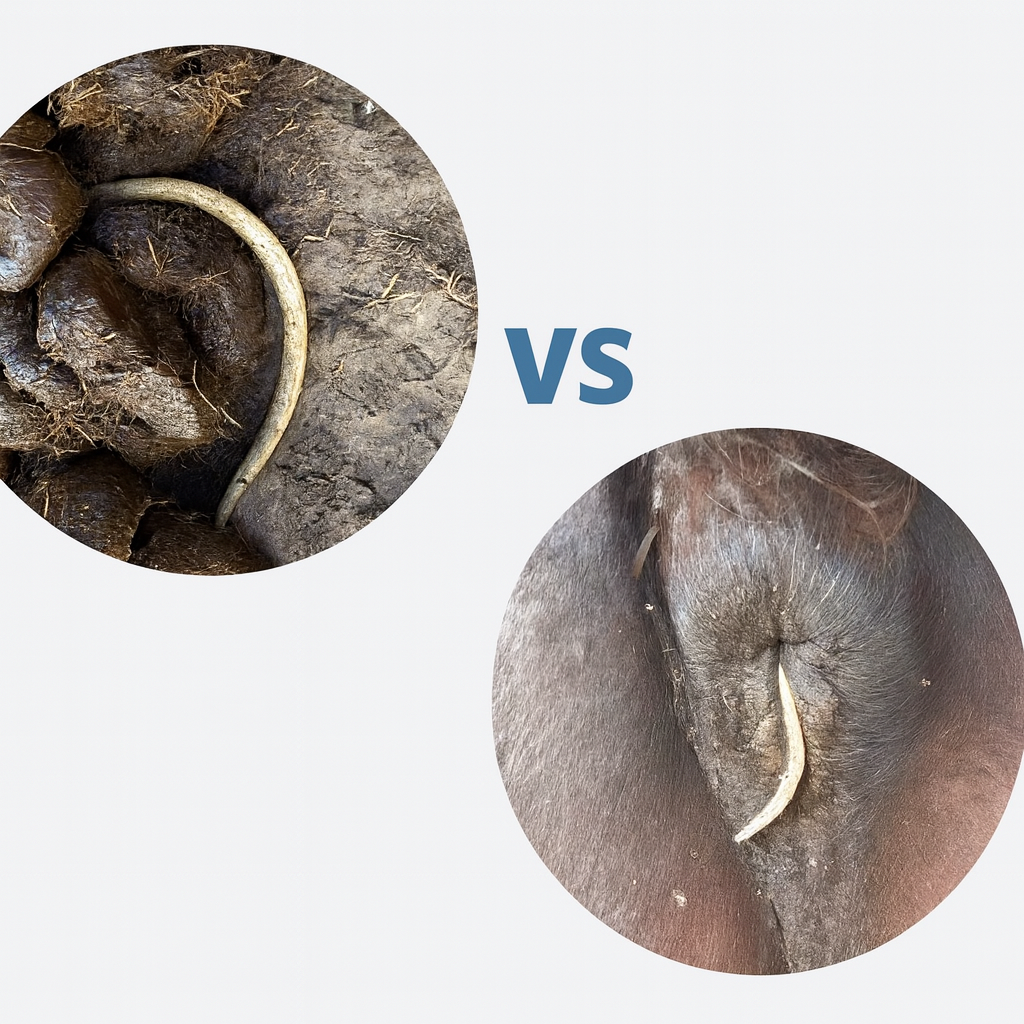
Pinworms are often mistaken for roundworms; they have a similar shape but differ greatly in size.
Roundworm
You mostly see roundworms in young horses up to around three years old. After that age, horses usually develop their own resistance. The adult roundworm is, like the pinworm, white and round, but much longer. They measure between 25 and 50 centimetres.
With a diameter of about half a centimetre, they are also thicker, much firmer, and harder. The adult roundworm lives in a very different part of the intestines than the pinworm. They reside in the small intestine, directly behind the stomach. The larvae penetrate the intestinal wall and reach the liver. After passing through the liver, they travel through the bloodstream to the lungs. Click here for the diagram.
Symptoms of a roundworm infection:
Pinworm:
The adult pinworm is a white, fairly small, soft, round worm with a very characteristic narrow, tapering tail. Pinworms can occur in horses of any age. They are occasionally seen on manure balls after deworming or by chance, and may be spotted around the anus as they lay their eggs. Immediately after egg-laying, they return through the anus to the intestine. The length of the worm varies: females are 10 to 15 centimeters long, males 1 to 2 centimeters. Fortunately, pinworms are relatively harmless intestinal parasites.
Symptoms of pinworm infection:
– Itching around the tail
– Worms visible in the manure
– Worms visible around the anus
– Yellow/white discharge
NOTE: Not every horse shows symptoms of a pinworm infection.
Have you found worms in the manure and are unsure whether it’s pinworm or roundworm? Feel free to contact us and send us a photo via WhatsApp — we’ll gladly take a look with you!
Want to learn more about pinworms and roundworms? Visit our website.

 NL
NL
 DE
DE
 FR
FR