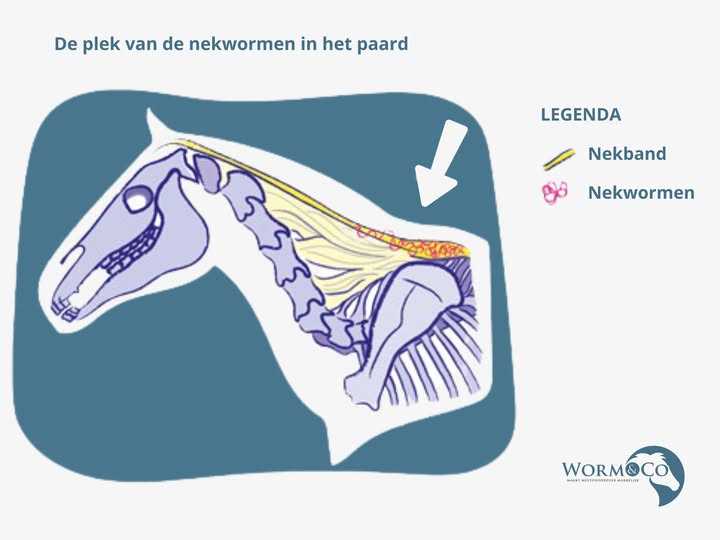
This parasite is rarely found in horses. The adult worm lives in the nuchal ligament and can live up to 10 years. These worms are long and thin (6–30 cm) and live in the nuchal ligament. Horses become infected when bitten by infected midges (Culicoides, also known as biting midges).
Symptoms
When a horse is infected, it shows rubbing behaviour, mainly around the head, neck, shoulders, and sometimes under the belly. Rubbing causes hair loss, sores, scabs and/or swelling. Horses may also develop small lumps along the underside of their neck.
Treatment
Because the worms never enter the intestines at any stage of their life cycle, they cannot be detected via fecal testing. Instead, a biopsy of the nuchal ligament may be required to confirm infection. However, ivermectin treatment can be used to keep the number of microfilariae — microscopic larvae that cause itching — as low as possible. This not only kills the microfilariae but also renders the adult female infertile for several months. After ivermectin treatment, itching may o
Life cycle
Adult neck threadworms can live up to 10 years, and their life cycle takes about 4–5 months to complete through a complex process that depends on an intermediate host: the midge (Culicoides sp.). Individual worms reproduce on their own without the need for males. They release thousands of tiny microscopic larvae, called microfilariae, each year from the nuchal ligament under the horse’s skin, with peak production occurring in spring.
Itching occurs where the microfilariae accumulate, attracting blood to the area and drawing biting midges that feed on the horse and ingest some of the Onchocerca larvae. These larvae develop further within the insect and are deposited into a new host horse a few days later when the midge feeds again.
Once transmitted back, the larvae travel to the nuchal ligament via the horse’s bloodstream, where they complete their development into adult worms and continue the life cycle.
To diagnose or treat neck threadworms, we advise you to contact your veterinarian.

 NL
NL
 DE
DE
 FR
FR